
International Health Organization IHO
Last updated: 24 October 2026
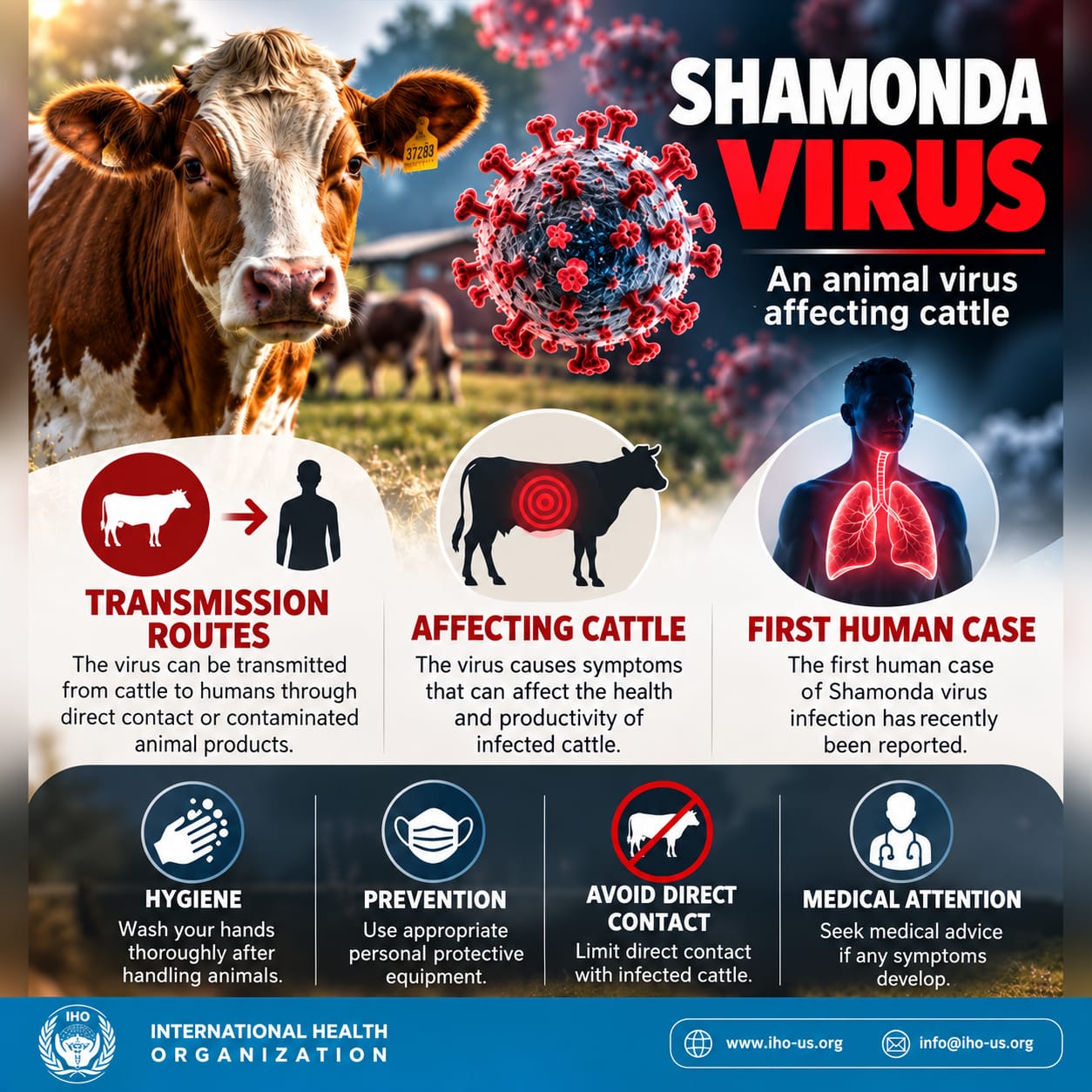
The announcement of the first documented human infection with Shamonda virus in France has drawn attention from the health and scientific communities, as the virus had been known for decades to infect animals. This development raises questions about its transmission and potential effects in humans. However, it does not, in itself, indicate the emergence of a human epidemic or establish that the virus can spread between people.
This article reviews the main official findings and available scientific studies, distinguishing between evidence established in animals and questions that remain under investigation in humans.
What Is Shamonda Virus?
Shamonda virus, scientifically abbreviated as SHAV, belongs to the genus Orthobunyavirus, within the family Peribunyaviridae and the Simbu serogroup. It is related to Schmallenberg virus, which is known to infect ruminants.
The virus was first isolated from cattle in Nigeria in 1965 and was subsequently detected in animals in parts of Africa and Japan. In 2026, its emergence in Europe was documented during investigations into disease affecting livestock herds. The new development is therefore the documentation of human infection, rather than the discovery of an entirely unknown virus.
What Do We Know About the First Human Infection?
On 22 October 2026, the European Centre for Disease Prevention and Control announced the first known human infection with the virus in France. The patient had a serious underlying illness and was severely immunocompromised, and died earlier that month.
The French National Institute of Health and Medical Research, Inserm, explained that neurological symptoms prompted extensive genetic testing, followed by tests that confirmed the presence of the virus in multiple samples collected on different dates.
This provides important evidence of human infection. However, determining the virus’s contribution to the death requires an assessment of the complete clinical picture, including the underlying disease and immune status. Detecting a virus in a deceased patient is not, on its own, sufficient to attribute all complications or the death to that virus.
How Is the Virus Transmitted?
In animals, Shamonda virus infection is associated with bites from small blood-feeding insects of the genus Culicoides, commonly known as biting midges. The specific species involved in transmission require further investigation.
In the French human case, a bite from an infected insect is considered the most likely explanation according to preliminary investigations, although this has not been conclusively established. As of the available official updates, no human-to-human transmission has been identified.
It is essential to distinguish between the absence of evidence of human-to-human transmission and proof that such transmission is impossible. Knowledge of this virus in humans remains at an early stage.
What Are the Main Scientific Studies?
1. Report of the First Human Infection — Eurosurveillance, October 2026
On 22 October 2026, the journal published a report entitled:
Fatal encephalitis caused by Shamonda virus Europe 1 (SHAV-EU1) in a patient with a severely weakened immune system, France, 2026.
The report describes fatal encephalitis associated with Shamonda virus Europe 1 in a severely immunocompromised patient.
Its significance lies in documenting human infection with a virus previously known primarily to affect animals. However, a single case report cannot establish the likelihood of infection in the general population, the typical pattern of symptoms, or complication and fatality rates. The clinical course of this case also cannot be generalised to people with healthy immune systems.
2. Study of Its Emergence in French Cattle — Eurosurveillance, August 2026
A study published on 20 August 2026 was entitled:
Detection of a novel Shamonda Orthobunyavirus in dairy cattle, France, June 2026.
Researchers began by investigating illness in nine dairy cattle herds in eastern France. Signs included diarrhoea, lethargy, reduced appetite and, in some cases, fever. These were accompanied by a decline in total herd milk production ranging from 15% to 75%.
The team used metagenomic sequencing to detect pathogen genetic material without restricting the investigation to a previously suspected virus, followed by additional molecular tests. The results identified a Simbu serogroup virus belonging to a distinct lineage of Shamonda virus.
The researchers expanded testing to include samples from affected cattle in 33 herds and samples from aborted fetuses in a further 18 herds, detecting viral genetic material in the samples examined.
These findings support an association between the virus and the observed animal disease. However, the study was neither a treatment trial nor a human study, and it did not include a formal analytical epidemiological investigation to establish all causal relationships. Its figures therefore cannot be used to estimate the risk or severity of infection in humans.
3. Study of Its Emergence in Central Europe — Emerging Infectious Diseases, Early Online Publication in 2026
A study entitled:
Emergence of Shamonda Orthobunyavirus, Central Europe, 2026
examined the emergence of an acute syndrome in dairy cattle in southern Germany and Switzerland, involving reduced milk production, diarrhoea, fever and lethargy.
After major viral causes had been excluded, molecular testing targeting Simbu serogroup viruses detected an orthobunyavirus. Metagenomic sequencing subsequently confirmed its identity and enabled the recovery of a complete Shamonda virus genome.
The researchers emphasised the importance of monitoring pregnant animals, expanding molecular and serological surveillance, and studying insect vectors. The study demonstrates the value of combining clinical examination with genetic analysis to detect emerging pathogens, but it does not provide a direct estimate of the risk to humans.
4. Study of Congenital Malformations in Calves — Emerging Infectious Diseases, June 2017
A Japanese study entitled:
Congenital Malformations of Calves Infected with Shamonda Virus, Southern Japan
documented 15 cases of calves with congenital malformations associated with intrauterine Shamonda virus infection during 2015 and 2016. The reported findings included joint stiffness and deformities, as well as central nervous system lesions.
This study is an important reference for understanding the virus’s effects on developing ruminant fetuses. However, it does not establish that the same effects occur in pregnant women or human fetuses. Conclusions concerning human pregnancy require independent human evidence.
Are There Known Symptoms in Humans?
A single human case is insufficient to establish a complete clinical description of the infection. Brain-related manifestations were reported in the announced case, in a patient who already had a complex medical condition.
It is therefore not currently possible to determine a consistent incubation period, the proportion of asymptomatic infections, or the frequency of neurological complications. Animal signs, such as diarrhoea and reduced milk production, do not constitute a description of the disease in humans.
How Was the Human Infection Detected?
Extensive genomic analyses helped direct the diagnosis towards Shamonda virus, and additional tests supported confirmation of infection in multiple samples.
This case highlights the role of specialised testing in investigating unexplained neurological illnesses, particularly in immunocompromised patients. It does not, however, indicate a need for routine Shamonda virus testing in the general population. French reference institutions are working to improve methods for detecting the virus in humans.
Does It Pose a Risk to the General Population?
According to the French public health agency, no evidence of human-to-human transmission or a health risk to the general population has been identified so far, based on the available information.
The reported case warrants careful scientific monitoring while avoiding two unsupported conclusions: that the virus marks the beginning of a human epidemic, or that there can be no future risk. Updates to the assessment will depend on investigation findings and the detection of any additional cases.
Is There a Treatment or Vaccine?
The World Health Organization states that there is currently no treatment or vaccine specifically for Shamonda virus. The evidence presented here does not include human clinical trials demonstrating the effectiveness of a particular medicine against it.
Why Is Coordinated Monitoring Essential?
Ongoing investigations bring together specialists in human, animal and environmental health through a One Health approach. These efforts include investigating the human case, comparing viral strains, monitoring infection in animals, and analysing insects potentially involved in transmission.
The International Health Organization IHO supports the dissemination of evidence-based health information and a clear distinction between established facts and hypotheses under investigation, while monitoring updates from the relevant scientific and public health authorities.